New support available for schools to inspire budding geographers
Ordnance Survey to provide free classroom resources through Digimap for Schools for more than a million schoolchildren in deprived areas
Press Office
Digimap for Schools was launched just over 15 years ago in partnership between OS and EDINA, at The University of Edinburgh. It is a flagship digital platform that provides interactive mapping tools for the teaching of geography, and other core education areas, in primary and secondary schools. It helps pupils and teachers develop digital and data skills, and explore modern and historical maps as well as aerial imagery. Around one-sixth of schools in England - more than 18 million pupils - have used the service since 2020.
The new offer means Digimap for Schools will reach more than one million schoolchildren in the most deprived areas across Britain, alongside three million who currently have access to the service. A programme of training will also be offered to educators, alongside the development of a new network of practising teachers to provide effective teaching support.
Free access to Digimap for Schools was previously sponsored by the government for schools rated Ofsted 3 or 4. This year, the eligibility criteria has been widened to include 1,800 schools in the lowest 8% of deprived areas in England and, for the first time, in Scotland and Wales. This will include cities such as Birmingham, Manchester, Cardiff, and Glasgow. The new offer has been secured by Government Digital Service, under the Public Sector Geospatial Agreement.
"It is fundamental that we support the effective teaching of geography in schools, building confidence when using interactive mapping tools, and fostering critical technical skills to grow our future geographers. We are delighted to announce the extension of Digimap for Schools to those with the greatest need in England, Scotland, and Wales. We encourage headteachers to take advantage of this offer and introduce Digimap for Schools into their classrooms this year."
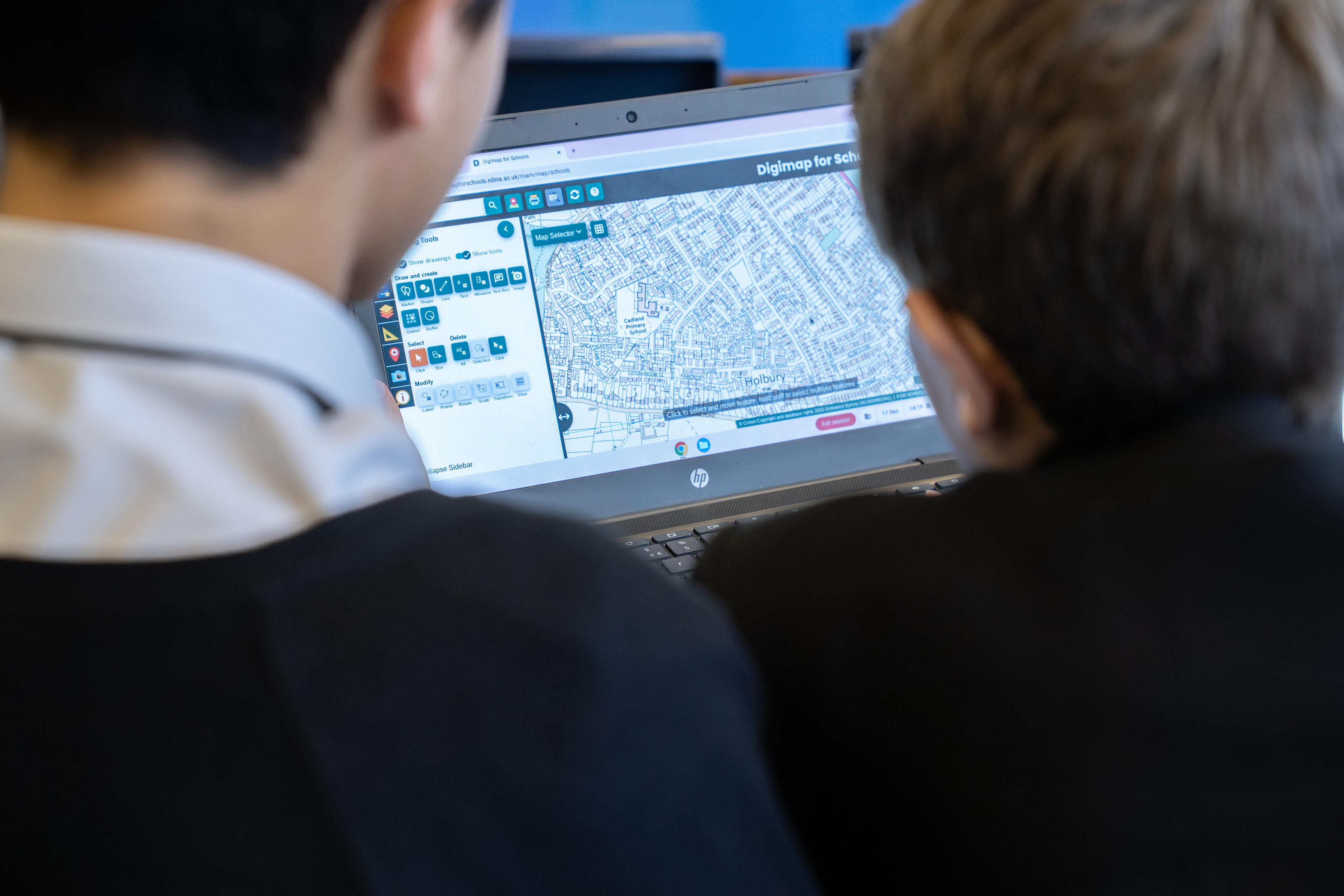
Noadswood School in Southampton, Hampshire, has been using Digimap for Schools for the last three years. The school’s Head of Geography, Jo Skinner, said they had seen a real increase in the number of students taking geography and great engagement from students using Digimap for Schools.
Jo Skinner, Head of Geography at Noadswood School, Hampshire, said:
"The real benefit of using Digimap for Schools is that it brings geography to life. We’ve mainly used it to boost our fieldwork where the students can gather information outside the classroom and then upload it onto a digital map where they can identify patterns. We’ve also used it to develop GIS skills, which are really important in the geography curriculum."
The overall number of students sitting geography GCSE exams has grown for 14 consecutive years, as understanding of its importance grows in addressing urgent issues like climate change, economic inequality, and migration. Geography is currently the sixth most popular subject at GCSE, with just under 300,000 students in England and Wales sitting exams last year.
Steve Brace, Chief Executive of the Geographical Association, said:
“Geography plays an important role in helping young people understand the world around them. Our members tell us that digital tools like Digimap for Schools are invaluable for geography teachers to enrich the curriculum learning experience and put data analysis directly into the hands of pupils. We welcome this initiative for schools in deprived areas, as well as the expansion into Scotland and Wales, and encourage all eligible schools to sign-up.”
Digimap for Schools is aligned with the national curricula across Great Britain and enables students aged five to 16 and above to understand and investigate their world while gaining crucial digital and data skills. It is supported by access to a huge library of free learning resources, also available in Welsh, that are designed to aid teaching and support teachers in preparing impactful and interesting lessons, as well as allowing for student-led self-study. Its main aims are to ensure that:
- schools and teachers have access to OS mapping and other complementary data such as aerial photography and historical maps;
- young people have a basic level of competency in using OS data and mapping;
- there is an understanding that geography can help solve problems in society;
- people understand how OS mapping touches the different stages of their lives;
- professional level competency is built across multiple domains; and
- geographic careers are promoted to help enhance skills training in key areas.
"This initiative marks a significant milestone in EDINA's ongoing collaboration with Ordnance Survey and shows its commitment to promoting geography and geospatial skills in schools. By providing equal access for high-quality educational resources, the University is helping to ensure that all students have the opportunity to reach their full potential. As EDINA celebrates its 30th anniversary, this latest initiative is a testament to the institution's reputation for innovation in educational technology and its role as a leader in the field."
OS recently published an impact report on its commitment to lifelong learning in geography and geospatial. It also collaborates closely with organisations such as the Royal Geographical Society and the Geographical Association on a wide range of activities including the teaching of geography in schools, educational outcomes, and promoting geography.
Headteachers of eligible schools will be directly contacted about the new offer in the next month. For further information about the Digimap for Schools free access scheme visit: https://digimapforschools.edina.ac.uk/about/imd/.
For more information about OS’s resources for schools, go to the teaching resources at www.ordnancesurvey.co.uk/education.
Sharing the latest news about OS. We can license you to use OS maps in print, online and film format. For more information and resources for journalists, bloggers and media professionals, email pressoffice@os.uk or call 023 8005 5565.
Find more news
- Education and recreation