Ordnance Survey’s new national retail area data confirms London is the country’s biggest shopping destination
The data also shows just over half of all retail areas are found out of town
Press Office
Due to be released into the OS National Geographic Database (NGD) at the end of March, the new dataset will provide consistently defined foundational geography of retail areas for the first time. It will be the first Functional Area dataset released by OS, which presents ‘notional geographies’ reflecting where types of activity happen - in this case, shopping.
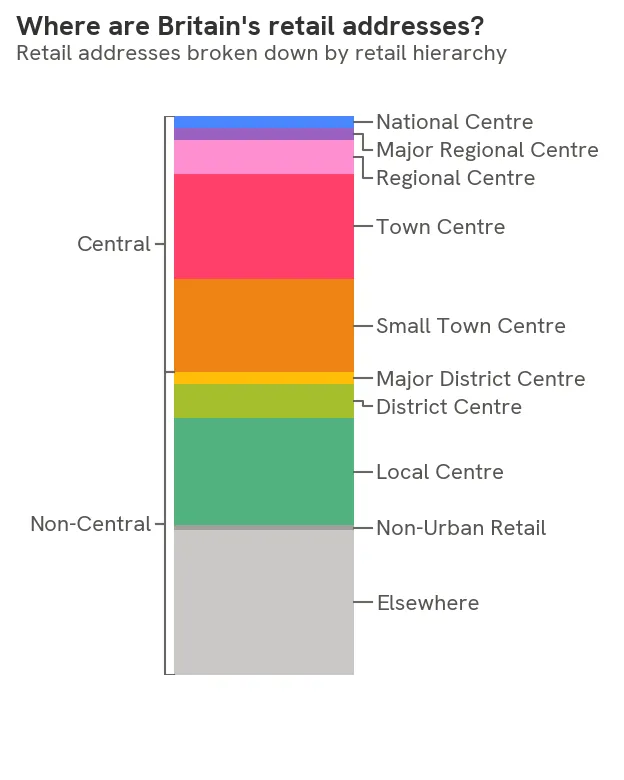
The new dataset will provide insights into more than 36,000 retail clusters across GB using three different types from largest to smallest: aggregated (where multiple high streets and shopping centres converge), major (such as a retail park) and minor (smaller clusters such as alleyways off high streets). The dataset also includes nine retail hierarchies, from national centres and major regional centres, down to small town centres and non-urban retail.
The new data will be particularly useful for central government in the creation of policy relating to local neighbourhoods and could be used to show how investment impacts areas with similar characteristics. Local authorities will also be able to use this foundational dataset for evidence-gathering and to define patterns of economic activity.
An early version of the dataset has already proved essential to the compilation of a brand new statistical analysis published by the Office of National Statistics today on high streets and retail areas. The Department for Business and Trade also used the data last year for its Green Paper on the future of the Post Office.
"The release of retail areas into the OS NGD is an exciting development, which brings to life an incredible level of information about the economic areas of our country. This is also the first of several notional geographies from OS, which will map different types of activities for the first time. It has been an immense privilege to collaborate so closely with ONS in its latest publication, of which our retail areas data plays an integral part."
Ahead of the retail areas release at the end of this month, OS can reveal that, nationally, just over half of all retail areas (54%) are found outside the town centre. The largest of those can be found in the London boroughs of Hammersmith and Fulham, then Islington. In third place is Boscombe in Bournemouth.
Perhaps not surprisingly, the largest single Aggregated Retail Area in the country is in London – accounting for 2.3% of all retail addressing.

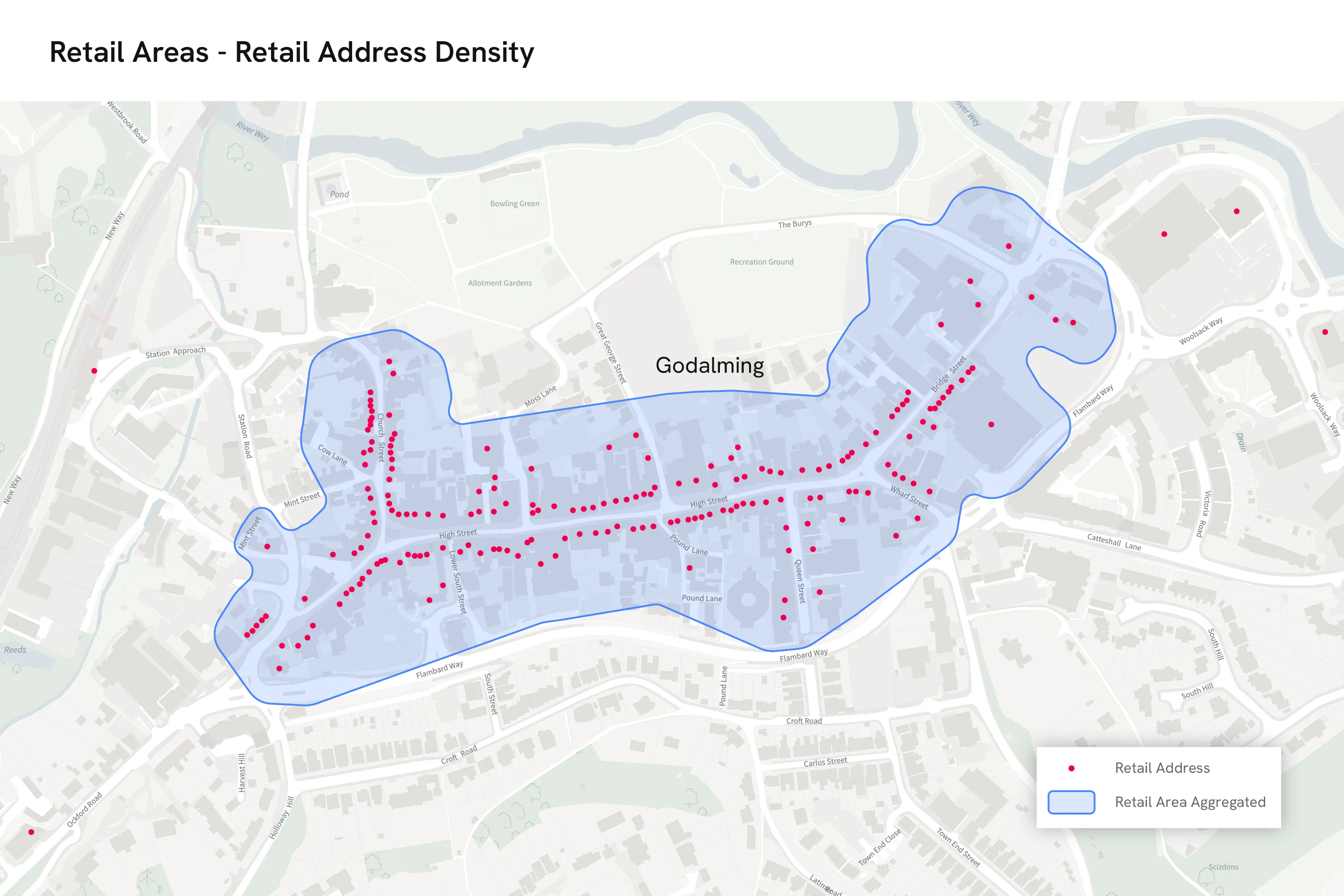
The data shows that residents’ experience of retail will be different depending on the size of the town they live in. While London has the biggest combined area of retail shopping, its other retail addresses are spread out across London and it has one of the lowest proportions of retail addresses in the centre. By contrast and smaller in size are a number of towns (such as Holmfirth, Godalming, and Winchcombe) which are more ‘retail compact’ with over 90% of their shops concentrated in one area. Three quarters of all national retail addresses are located in an Aggregated Retail Area, alongside other shopping outlets.
The retail areas data has been designed in collaboration with ONS, Scottish Government, Department for Business and Trade, and other central government departments. It will be released into the OS NGD at the end of March as part of the Public Sector Geospatial Agreement (PSGA). The PSGA is a contract between Government Digital Service, managed on behalf of the UK Government, and OS for the provision of geospatial data and services to the emergency services and wider public sector organisations.
To access all of OS’s location data visit the OS Data Hub – which provides access to the data through both APIs and downloads.
Sharing the latest news about OS. We can license you to use OS maps in print, online and film format. For more information and resources for journalists, bloggers and media professionals, email pressoffice@os.uk or call 023 8005 5565.
Ordnance Survey National Geographic Database
Find more news
- Built environment
- Partners
- PSGA members
- Retail
- Government and public sector
- Economy and business